
Why Businesses Are Moving Beyond Traditional Keys
A key fob entry system has become one of the most common ways businesses manage secure building access. Unlike traditional keys that can be copied, misplaced, or difficult to track, electronic credentials allow organizations to control who can enter specific areas while simplifying day-to-day access management. Whether used in offices, warehouses, healthcare facilities, or commercial buildings, key fob systems help businesses replace manual key management with a more flexible and centralized approach.
Understanding how commercial access control works makes it easier to see why many organizations have adopted electronic credentials as part of their everyday operations.
What Is a Key Fob Entry System?
A key fob entry system is an electronic access control solution that allows authorized users to unlock secured doors using a small credential instead of a traditional key.
Each key fob contains an RFID credential that communicates with a reader installed near the door. When the credential is recognized and the user has permission to enter, the system releases the electronic lock. If authorization isn’t granted, the door remains secured.
Because permissions are managed electronically, businesses can update user access without changing locks or issuing new keys throughout the building.
How Does a Commercial Key Fob Entry System Work?
Although the process happens in seconds, several components work together every time someone presents a credential at a secured door.
Step 1: Presenting the Credential
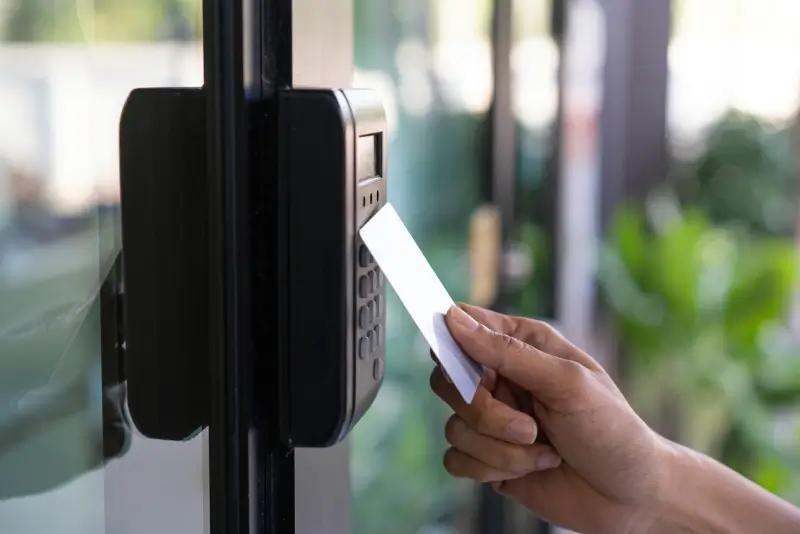
An employee or authorized visitor places their key fob near a proximity card reader installed beside the door.
Step 2: Verifying Access
The reader sends the credential information to the system, where an access control panel verifies whether the user has permission to enter that location.
Step 3: Unlocking the Door
If the credential is authorized, the connected door controller releases the locking hardware, allowing entry. If permission isn’t available, the door remains locked.
This entire process typically occurs within moments while maintaining control over who can access different parts of the facility.
The Components Behind Commercial Key Fob Entry
Several technologies work together to create a commercial key fob entry system.
RFID Credential
An RFID credential contains a unique electronic identifier assigned to an individual user.
Proximity Card Reader
The proximity card reader detects the credential and transfers its information to the access control system for verification.
Access Control Panel
The access control panel serves as the system’s decision-making component by determining whether the presented credential has authorization for that specific door.
Door Controller
The door controller communicates with the locking hardware, unlocking or securing the entrance based on the access decision.
Credential Management Software
Credential management software allows administrators to issue credentials, update permissions, deactivate users, and organize access throughout the facility.
How Businesses Manage Employee Access
One advantage of business-oriented fob access control systems is the ability to assign different access permissions to different users.
Rather than providing every employee with identical access, businesses can create permissions based on operational responsibilities. For example, administrative staff, warehouse personnel, managers, and contractors may each receive different levels of access depending on the areas they need to enter.
Because permissions are managed electronically, access can be updated whenever job roles or operational needs change.
What Happens If a Key Fob Is Lost?
Misplaced keys often create uncertainty because businesses cannot always determine who may have access to the building.
With a key fob door access system, administrators can perform lost fob deactivation, preventing the missing credential from unlocking secured doors. A replacement credential can then be issued without replacing locks or affecting other authorized users.
This capability is one of the reasons many businesses transition from traditional keys to electronic credentials.
How Key Fob Systems Support Everyday Business Operations
Beyond controlling entry, key fob systems simplify routine administrative tasks associated with managing building access.
Businesses can:
- Add new employees
- Remove former employees
- Update access permissions
- Issue temporary credentials
- Manage contractor access
- Organize access by department or location
Electronic credential management allows organizations to adjust building access as operations change without relying on physical keys.
Can Key Fob Entry Work With Other Commercial Security Systems?
A key fob entry system often operates as part of a broader commercial security solution. Many businesses choose to connect access control with surveillance or intrusion detection systems to improve visibility around secured entrances and support facility management.
Integrating these technologies can provide additional operational awareness while allowing businesses to manage multiple security functions more efficiently.
Honor Security provides commercial access control solutions for businesses throughout Saginaw, Bay City, Midland, and the surrounding Great Lakes Bay Region. Whether you’re replacing traditional keys or exploring a keyless fob entry office solution, our team can help design commercial access control systems that align with your facility’s operational needs.
Talk to an Honor Security Expert
Frequently Asked Questions About Key Fob Entry Systems
Can a key fob entry system be installed in an existing commercial building?
In many cases, yes. A key fob entry system can often be added to existing commercial buildings, depending on the current door hardware, electrical infrastructure, and operational requirements. A professional assessment helps determine the most appropriate solution.
Can one key fob provide access to multiple doors?
Yes. A single RFID credential can be programmed to unlock multiple authorized doors, while access permissions remain specific to each user’s role and responsibilities.
Can access permissions be changed without issuing a new key fob?
Yes. Businesses can update permissions through credential management software, allowing the same credential to gain access to new areas or restrict access to existing ones without replacing the physical key fob.
What happens if an employee leaves the company?
Administrators can remove or modify the employee’s access permissions through the access control system. This eliminates the need to recover every physical key or replace building locks when staffing changes occur.
Do key fob entry systems require internet access to unlock doors?
System capabilities vary depending on the access control solution and how it is configured. Businesses should discuss connectivity requirements with their security provider when selecting a commercial access control system.
Can businesses track who entered a secured area?
Many commercial access control systems maintain electronic records of authorized entry activity. Depending on the system, these records can help businesses review access events and support routine facility management.
Can businesses use different types of access credentials?
Yes. Depending on the access control system, businesses may use RFID credentials, proximity cards, or other supported credential types to meet their operational requirements.
Who installs commercial key fob entry systems in the Great Lakes Bay Region?
Businesses throughout Saginaw, Bay City, Midland, and the surrounding Great Lakes Bay Region can work with Honor Security to evaluate commercial access control needs and implement key fob door access system solutions that support secure, efficient facility access.