
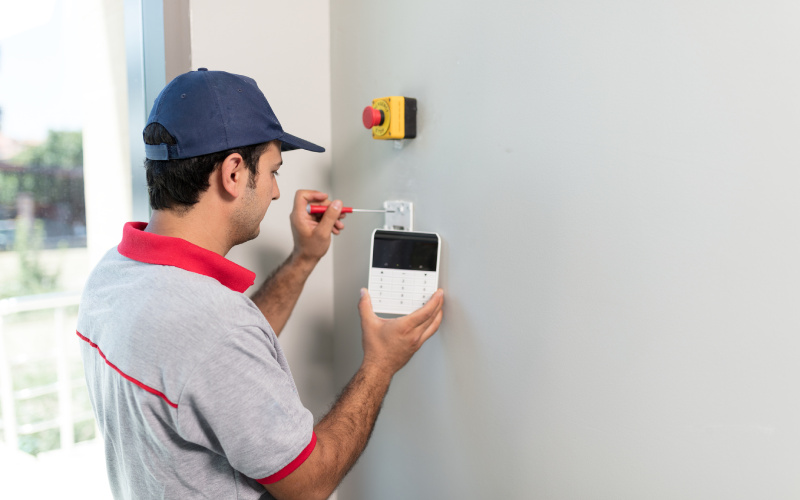
How Much Do Commercial Alarm Systems Really Cost in 2026? A Michigan Business Owner’s Guide
Commercial Alarm Systems Cost
You locked up last Tuesday night. Wednesday morning, you walked in to find a broken side door, missing equipment, and a sinking feeling that a security system would have cost a fraction of what you just lost. It’s a scenario that plays out for Michigan business owners every week — and the most common thing our team at Honor Security hears afterward is, “I just didn’t know what it would cost.”
That uncertainty stops here. This guide breaks down commercial alarm systems cost from every angle — hardware, installation, monitoring, permits, and the lease-versus-buy decision — so you can walk into any conversation with a security provider fully informed. By the end, you’ll know exactly what to budget, what to watch out for, and how to evaluate whether you’re getting real value or just a number on a proposal.
What Is a Commercial Alarm System?
A commercial alarm system is a professionally engineered security solution designed to detect, notify, and deter unauthorized access, intrusion, fire, environmental hazards, and other threats in a business environment. Unlike residential systems, commercial-grade deployments are built around the specific risk profile, square footage, and operational hours of a business.
A complete system typically includes a central control panel, door and window contact sensors, interior and exterior motion detectors, glass-break sensors, a keypad or mobile management interface, and a 24/7 UL-listed monitoring connection. Depending on your facility, it may also integrate with access control, surveillance cameras, and environmental monitoring like Winland humidity and temperature sensors — all of which Honor Security designs and installs across Michigan.
| System Type | Typical Components | Best For |
| Basic Intrusion Alarm | Panel, door/window contacts, motion sensor | Small retail, office suites |
| Integrated Commercial System | Above + cameras, access control | Warehouses, multi-tenant facilities |
| Enterprise / Multi-Site | Full integration + remote management | Manufacturers, school campuses |
Why Commercial Alarm Systems Cost Is a Business-Critical Number
The cost of a commercial alarm system isn’t just a line item — it’s a risk calculation.
According to FBI crime data (transitioning from the Uniform Crime Reporting program to the National Incident-Based Reporting System, or NIBRS), commercial burglary incidents regularly result in losses in the range of roughly $1,500 to $4,000 per event, depending on business type and region. That figure does not include downtime, insurance deductibles, or operational disruption.
A visible, professionally monitored alarm system changes offender behavior before an incident occurs. In physical security, deterrence is often the highest-return feature you can invest in.
There’s also an insurance component. Many commercial property insurers offer premium discounts — commonly cited in the 5% to 20% range — when a UL-listed monitored alarm system is installed. Exact savings vary by carrier and policy, so business owners should confirm directly with their insurer.
Ignoring the alarm system cost doesn’t eliminate the expense — it shifts it to an unpredictable, higher-impact loss event.
Key Factors That Determine Your Commercial Alarm System Price
Facility Size and Number of Entry Points
The largest driver of upfront cost is coverage area. A 1,500 sq ft retail unit with two entry points requires far fewer sensors than a 20,000 sq ft facility with multiple access points and interior zones.
For most small businesses, professionally installed commercial alarm systems typically fall between $1,500 and $3,000. More complex or integrated systems — including video or access control — commonly range from $3,000 to $5,000 or more.
Before any quote is meaningful, a site assessment is essential. System design directly determines both cost and effectiveness.
System Type and Technology Tier
A standard burglar alarm panel with door contacts and one motion detector sits at a very different price point than a fully integrated system combining intrusion detection, video surveillance, and cloud-based access control managed from a mobile app. Intrusion sensors for commercial properties range from $75 to $600 each, depending on type and application, and access control averages around $3,000 per door for hardware and wiring. The technology you choose should match your actual risk level — not just what’s being sold.
Professional Monitoring
This is the recurring cost that most business owners underestimate when budgeting. Professional 24/7 monitoring for a commercial security system costs around $40 to $120 per monthly monitoring fees. The lower end covers standard signal monitoring. The higher end includes video-verified monitoring, where a trained operator visually confirms an event before dispatching law enforcement — significantly improving police response priority and nearly eliminating costly false alarm fines.
False alarms are a major cost driver in monitored security systems. Industry and municipal data frequently show that the vast majority of alarm dispatches are false alarms — often cited in the 90%+ range depending on jurisdiction.
Many cities impose escalating fines for repeated false alarms, commonly starting at around $50 to $150 per incident. Policies vary widely by municipality, and business owners should review local ordinances when budgeting.
Advanced solutions like video-verified monitoring are designed to reduce false dispatches by confirming events before police are notified, which can help avoid fines and improve response priority.
Installation Labor and System Complexity
Labor is not a flat fee. A wired system in a concrete-walled industrial facility costs more to install than a wireless deployment in a newer office build. Systems that require conduit runs, elevated sensor placement, or integration with existing infrastructure will carry higher labor costs. Always ask for an itemized quote that separates equipment from installation.
Alarm Permits and Local Fees
Alarm permits are a mandatory budget line item in most U.S. cities, typically running $30 to $110 annually per location — and most initial quotes leave this out entirely. In Michigan, permit requirements vary by municipality. Honor Security’s team routinely helps clients navigate local permitting so there are no surprise fees after installation.
The Lease vs. Buy Alarm System: What No One Tells You
This is the conversation that can save — or cost — you thousands over the life of your system, and it rarely gets the attention it deserves.
Leasing a commercial alarm system typically involves lower upfront costs and includes the equipment in a monthly payment, which appeals to businesses managing cash flow. But there are real tradeoffs. Leasing might seem attractive with its lower upfront cost, but you could end up paying more over the long run without ever owning the hardware. Some lease agreements also restrict upgrades, tie equipment to monitoring contracts with high cancellation fees, and include automatic renewal clauses written in fine print.
Purchasing outright means a higher initial investment but full ownership, no contract lock-in, and the freedom to switch monitoring providers if your needs change. For businesses with stable locations and a 3-to-5-year planning horizon, purchase usually wins on the total cost of ownership.
A middle path worth considering: manufacturer financing programs. Several commercial-grade platform providers offer structured payment plans that preserve ownership without the punitive terms of traditional leasing. Ask your integrator explicitly which option applies before you sign.
Common Mistakes Michigan Business Owners Make When Buying a Commercial Alarm System
Going with the cheapest quote without understanding what’s included. A $500 system that covers two doors on a 10,000 sq ft building isn’t a security system — it’s a checkbox. The quote that looks best on paper often delivers the least coverage per dollar.
Skipping professional monitoring. Self-monitored systems put the burden of response entirely on the owner. If an alarm triggers at 2:00 AM and you’re unavailable or asleep, nothing happens. Video-verified monitoring eliminates most false alarm exposure and typically improves police response priority in ways that purely self-monitored setups cannot match.
Not planning for ongoing costs. Sensor batteries require replacement every one to two years, panel batteries last three to five years, and permits renewals annually. These costs are rarely included in standard monitoring contracts but accumulate significantly across a multi-sensor commercial deployment.
Treating the system as a set-it-and-forget-it installation. Businesses evolve. New entry points are added, layouts change, and staff turnover affects access permissions. A security system that isn’t periodically reviewed and updated becomes less effective over time. Honor Security offers preventive maintenance services — proactive checks that catch failing components before they fail on the worst possible night.
What Does a Commercial Alarm System Actually Cost in Michigan in 2026?
What Does a Commercial Alarm System Actually Cost in Michigan in 2026?
A realistic baseline for most small-to-mid-size businesses:
- Equipment + professional installation: $1,500 to $3,000
- Monitoring: $40 to $120 per month
- Permits: $30 to $110 annually
This puts a typical first-year investment in the $3,000 to $7,000 range for a standard commercial deployment.
More advanced systems — including fire integration, access control, or multi-site coverage — can increase costs significantly, often exceeding $5,000+ depending on scope and code requirements.
The only precise number comes from a site-specific assessment, but this framework reflects what most Michigan businesses actually pay.
Ready to get a clear, honest number for your specific building?
Get Your Free Security Assessment – Book a Consultation
Questions Michigan Business Owners Are Actually Asking About Alarm System Costs
What is the average monthly cost for commercial alarm monitoring in Michigan?
Quick answer: Most businesses pay between $40 and $120 per month, depending on features.
Most businesses in Michigan pay between $40 and $120 per month for professional monitoring, depending on the service tier. Standard signal-only monitoring sits toward the lower end. Video-verified monitoring with faster police dispatch priority runs higher but substantially reduces false alarm fines and improves response outcomes for genuine events.
Does a business alarm system lower my insurance premium?
Quick answer: Yes—many insurers offer 5% to 20% discounts for monitored systems.
In many cases, yes. Commercial property insurers often reduce premiums by 5% to 20% when a UL-listed, professionally monitored alarm system is installed. The exact discount depends on your carrier and policy. Contact your insurer directly once a system is in place to have your premium reviewed — many business owners miss this step entirely.
How long does it take to install a commercial alarm system?
Quick answer: Simple systems take 1–2 days; complex setups can take up to 4 weeks.
Installation timelines vary by system complexity. A straightforward intrusion detection setup for a small business may take one to two days. More integrated systems combining cameras, access control, and intercoms can take one to four weeks from initial design consultation to full commissioning. Honor Security’s process starts with a site assessment so you know what to expect before work begins.
Do I need a permit for a commercial alarm system in Michigan?
Quick answer: Yes—most cities require a permit and may charge annual fees.
Most Michigan municipalities require an alarm permit to operate a monitored commercial system. Annual permit fees typically range from $30 to $110. Some cities also issue fines for false alarms beyond a set threshold. Your security integrator should help you navigate local permitting requirements — if they don’t mention it, ask.
Is it worth buying a commercial alarm system for a small business?
Quick answer: Yes—the protection, insurance savings, and deterrence often outweigh the cost.
Yes — particularly when you calculate total exposure rather than just upfront cost. A single commercial burglary averaging $1,500 to $4,000 in losses can exceed the full cost of a basic monitored alarm system. Add potential insurance savings and the deterrence effect on would-be intruders, and the alarm system ROI case for even a modest system is straightforward.
Understanding all aspects of your facility’s security starts with the right foundation. Learn more about how Honor Security approaches protection from the ground up on our intrusion detection page.
Conclusion: The Real Cost of a Commercial Alarm System Is What You Pay Without One
‘How much does a commercial alarm system cost?’ is a question every Michigan business owner deserves a straight answer to — not a vague range designed to get someone through your door. So what should you realistically expect?
For most small-to mid-size Michigan businesses, a properly designed commercial alarm system typically costs:
- $1,500 to $3,000 upfront for standard systems
- Up to $5,000+ for more advanced or integrated setups
- $40 to $120 per month for monitoring
That’s a meaningful investment — but still often less than the cost of a single burglary event when you factor in losses, downtime, and insurance exposure.
The real risk isn’t overpaying for a system. It’s delaying the decision until after a preventable loss.
A clear, accurate quote starts with understanding your building, your risk profile, and your operational needs — not guessing from inconsistent price ranges.
Call Honor Security today or book your free on-site consultation — and know exactly what protecting your business will actually cost.
Book a Free Consultation With Honor Security
Frequently Asked Questions
What is included in a commercial alarm system installation?
Quick answer: It includes hardware, programming, monitoring setup, and full system testing.
A professional commercial installation includes more than hardware. A complete installation covers the control panel, door, and window contact sensors, motion detectors, keypad programming, UL-listed monitoring connection, and system testing. Depending on your facility, it may also include access control integration, surveillance cameras, and environmental monitoring. Ask for a written scope before any work begins.
Can I use a home security system for my business?
Quick answer: No—residential systems lack the capability and compliance needed for commercial use.
Home security systems are not engineered for commercial demands. Residential systems lack the sensor density, zone programming depth, and commercial-grade monitoring integrations that businesses require. They also typically don’t satisfy insurance requirements or local code standards for commercial properties. A professionally designed commercial system is a different category of protection.
What factors make commercial alarm systems more expensive?
Quick answer: Size, sensor count, and system integrations are the biggest cost drivers.
Building size, sensor count, and system integration are the primary cost drivers. Larger facilities require more sensors, longer cable runs, and more complex zone programming. Integrating cameras, access control, or intercoms into a unified platform adds both equipment and labor costs. The technology tier — standard versus AI-assisted or video-verified — also significantly affects equipment and installation pricing.
How often does a commercial alarm system need to be serviced?
Quick answer: At least once a year, with preventive maintenance recommended.
Annual preventive maintenance is the industry standard for commercial systems. Sensor batteries, panel batteries, communication modules, and tamper detection components all have maintenance intervals. Proactive servicing catches issues before they result in a system failure during an actual event. Honor Security offers scheduled maintenance to keep your system fully operational year-round — and is currently offering 10% off.
What is video-verified monitoring, and is it worth the extra cost?
Quick answer: It confirms alarms visually, reducing false alarms and improving response times.
Video verification means a trained operator visually confirms an alarm before dispatching police. This dramatically reduces false alarm dispatches (and the fines that come with them), while simultaneously increasing police response priority for confirmed events. For businesses with higher foot traffic, irregular hours, or high-value inventory, the business alarm system cost is typically recovered quickly in avoided fines alone.
Does Honor Security serve businesses outside Saginaw?
Quick answer: Yes—services are available across the entire state of Michigan.
Yes — Honor Security serves the entire state of Michigan. While headquartered in Saginaw and deeply rooted in the Great Lakes Bay Area, Honor Security designs and installs commercial security systems for businesses throughout Michigan, including warehouses, retail operations, multi-tenant facilities, and industrial properties.
What’s the difference between a burglar alarm and a full commercial security system?
Quick answer: A burglar alarm detects intrusions, while a full system integrates multiple security layers.
A burglar alarm is one component; a full commercial system is an integrated platform. A standalone burglar alarm detects and alerts. A fully integrated commercial system combines intrusion detection, video surveillance, access control, and environmental monitoring into a single managed solution — giving you visibility, control, and response capability across every security layer of your facility.