 Skip to content

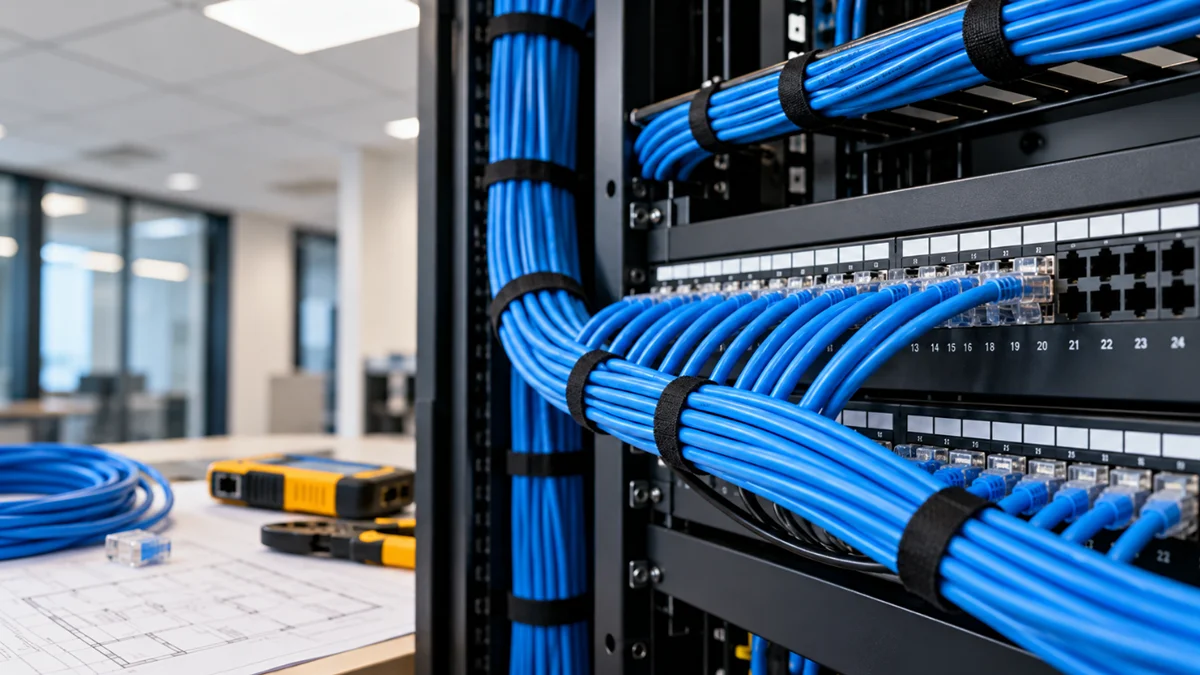
Voice data cabling is the physical infrastructure that carries phone, internet, network, video, security, and other low-voltage communications throughout a building.
Although wireless connectivity is common in U.S. businesses, most wireless and IP-based systems still depend on wired infrastructure behind the scenes. Computers, VoIP phones, Wi-Fi access points, surveillance cameras, access-control systems, intercoms, and other connected devices ultimately rely on a well-designed cabling network.
A properly planned system can improve network reliability, simplify troubleshooting, make future expansion easier, and provide the foundation for new technology as a business grows.
What Is Voice Data Cabling?
Voice data cabling refers to copper or fiber-optic wiring used to transmit telephone and digital network communications throughout a commercial facility.
Older buildings often had separate wiring systems for telephones and computers. Modern data and voice cabling is more commonly designed as one organized infrastructure capable of supporting Ethernet, VoIP phones, wireless access points, IP cameras, security devices, printers, and other network-connected equipment.
When these connections are installed as a structured system, cables, outlets, patch panels, network rooms, and pathways follow a consistent design instead of being added as unrelated cable runs over time.
What Is the Difference Between Voice Cabling and Data Cabling?
Traditional voice cabling was mainly used for telephone systems, while data cabling connected computers, servers, switches, and other network equipment.
That distinction has become less important because many businesses now use Voice over Internet Protocol, or VoIP.
A VoIP phone can connect directly to an Ethernet network, and some phones can provide a pass-through network connection for a computer. Because of this, businesses increasingly design a single structured network capable of supporting both voice and data rather than maintaining completely separate systems.
How Structured Cabling Supports Voice and Data
A structured cable system organizes telecommunications infrastructure into clearly defined components. These can include telecommunications rooms, equipment racks, backbone cabling, horizontal cabling, patch panels, work-area outlets, cable pathways, and network cabinets.
In the United States, the TIA-568 family is one of the principal standards used for commercial-building telecommunications cabling. The Telecommunications Industry Association identifies TIA-568 specifically as its Commercial Building Telecommunications Cabling Standards.
Following an organized cabling architecture also makes it easier for a facility to replace equipment or change technology without rebuilding the entire physical network.
Common Cable Types Used for Voice Data Cabling
Cat5e Cabling
Category 5e remains installed in many existing commercial buildings. It can support common Ethernet applications and may continue to meet the needs of some existing networks.
For new projects, however, businesses often evaluate newer cable categories based on expected bandwidth, equipment requirements, and future expansion.
Cat6 Cabling
Cat6 is widely used for commercial Ethernet installations. It is commonly connected to computers, VoIP phones, wireless access points, IP security cameras, access-control equipment, and other network devices.
It provides more performance headroom than older Cat5e infrastructure and is a common choice for general commercial network installations.
Cat6A Cabling
Cat6A is frequently considered for higher-bandwidth commercial environments and applications requiring 10 Gigabit Ethernet over standard horizontal copper distances.
It may also make sense where a business expects growing bandwidth requirements or extensive use of Power over Ethernet devices.
Fiber-Optic Cabling
Fiber-optic cable is commonly used for building backbones, longer-distance connections, connections between floors or buildings, and high-capacity network links.
TIA guidance recognizes both balanced twisted-pair copper and optical fiber as important parts of structured telecommunications infrastructure.
A facility may therefore use fiber between network rooms while using Cat6 or Cat6A to connect individual devices.
What Equipment Is Included in a Voice Data Cabling System?
The cable itself is only one component of voice data cabling.
A complete installation can include wall outlets, patch panels, equipment racks, network cabinets, patch cords, cable managers, cable pathways, labels, and terminations inside the telecommunications room.
Organization matters because an undocumented network can become difficult and expensive to maintain.
Proper labeling allows technicians to identify where each connection begins and ends. That makes moves, additions, repairs, equipment changes, and network expansion considerably easier.
How Is Voice Data Cabling Installed?
A commercial cabling project normally begins with a site assessment.
The installer identifies where workstations, telephones, wireless access points, cameras, access-control equipment, network switches, and other devices will be located.
Cable pathways are then planned to reduce physical damage, interference, unnecessary bends, inaccessible runs, and future maintenance problems.
Cables are routed through approved pathways, terminated at outlets and patch panels, labeled, and tested before the system is placed into service.
For U.S. facilities, cable selection and installation can also depend on building construction, cable pathways, applicable electrical and fire requirements, and local code adoption. For this reason, a cable should not be selected solely on speed or category.
Why Cabling Testing Matters
A cable can look perfectly installed while still suffering from performance problems caused by a damaged conductor, poor termination, excessive length, improper routing, or another installation issue.
Testing helps confirm that installed cabling performs as expected for its intended category and application.
Documentation of those tests also gives building owners and IT teams a useful baseline. If network problems develop later, technicians have better information for determining whether the issue is the cabling, network equipment, or another component.
What Systems Can Use Voice Data Cabling?
Modern data and voice cabling can support far more than desktop computers and telephones.
The same network infrastructure may support Wi-Fi access points, IP surveillance cameras, access-control systems, intercoms, printers, conference-room technology, digital signage, building-management equipment, environmental sensors, and other IP-connected technologies.
This is why cabling should be planned as long-term infrastructure rather than only around the equipment a business owns today.
A company adding security cameras, for example, should consider whether the network can support the additional bandwidth, switch capacity, Power over Ethernet demand, and physical cable runs that the new cameras require.
When Should a Business Upgrade Its Cabling?
A cabling review may be worthwhile when a facility experiences recurring network drops, damaged wiring, unidentified cables, limited Ethernet outlets, overcrowded network closets, or difficulty supporting newer equipment.
Office renovations, expansions, VoIP migrations, Wi-Fi upgrades, new surveillance systems, access-control installations, and facility relocations are also good opportunities to evaluate existing infrastructure.
The goal is not necessarily to replace every cable. A qualified installer can determine what existing infrastructure can remain and what should be upgraded to support current and future requirements.
Frequently Asked Questions About Voice Data Cabling
What is voice data cabling?
Voice data cabling is the copper or fiber infrastructure used to carry telephone and digital network communications throughout a building. Modern systems can support computers, VoIP phones, wireless access points, cameras, access control, and other IP devices.
Which cable is used for voice and data communication?
Cat5e, Cat6, Cat6A, and fiber can all be used depending on the required bandwidth, distance, equipment, and building environment. Cat6 and Cat6A are common choices for newer commercial copper installations.
Is structured cabling the same as voice and data cabling?
The terms are closely related. A structured cable system refers to the organized architecture of the entire telecommunications infrastructure. Data and voice cabling describe the cabling carrying those communications.
Can the same Ethernet connection support a VoIP phone and computer?
Often, yes. Many business VoIP phones can connect to an Ethernet outlet and provide a second Ethernet connection for a workstation, depending on the network design and phone hardware.
Why is labeling important in structured cabling?
Labeling helps technicians identify cables, ports, rooms, and endpoints quickly. This reduces troubleshooting time and makes network changes and expansion easier.
Voice Data Cabling in Saginaw, Bay City, Midland and Across Michigan
Businesses looking for professional voice data cabling in Michigan need more than cables pulled from one room to another. The infrastructure should account for network devices, security equipment, future expansion, testing, labeling, and ongoing service.
Honor Security is headquartered in Saginaw and serves commercial customers throughout Michigan. Its published coverage includes Saginaw, Saginaw Township, Bay City, Midland, Frankenmuth, Bridgeport, Birch Run, Auburn, and Freeland, with extended coverage into Flint, Mt. Pleasant, Owosso, and other Michigan commercial markets.
Honor Security is a strong local choice for structured cable and data and voice cabling projects because cabling can be planned alongside the systems that depend on it. Honor Security lists Structured Cabling among its additional security technologies and supports businesses with professional installation, integrated security systems, ongoing service, preventive maintenance, and local support.
Planning a new network, facility expansion, security-system installation, or cabling upgrade? Contact Honor Security to discuss a voice data cabling solution designed around your Michigan facility and future technology needs.
