 Skip to content

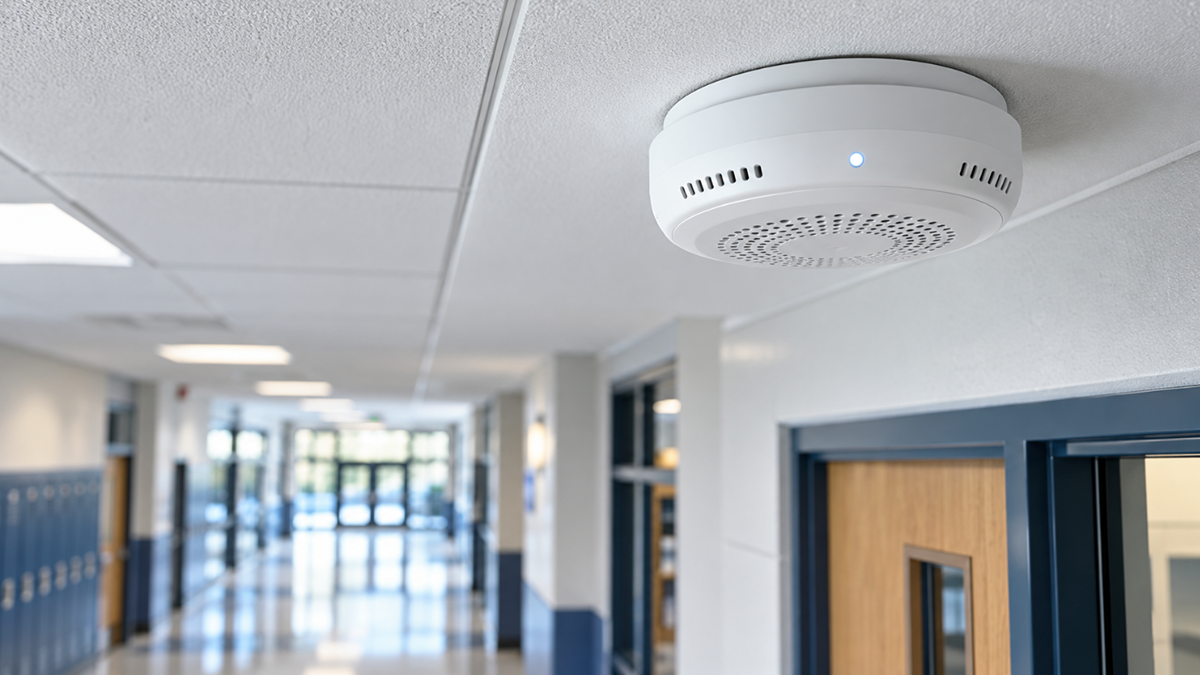
If you are trying to identify a vape sensor, the short answer is simple: what does a vape detector look like? In most buildings, it looks like a compact white device mounted on a ceiling or high on a wall. Many models resemble a smoke detector, carbon monoxide alarm, Wi-Fi access point, or small environmental sensor, which helps them blend into the surrounding space.
The exact shape varies by manufacturer. Some units are circular, while others are square or rectangular. Many have small ventilation openings, status lights, sensor openings, and a low-profile housing designed for indoor use.
What Does a Vape Detector Look Like Up Close?
A typical vape detector has several visual characteristics that can help you recognize it.
Small, Discreet Housing
Most units are intentionally compact. They are designed to monitor indoor air without becoming visually distracting. White or light-colored housings are common because they blend with ceilings and walls.
Vents or Air Openings
Unlike a standard camera, a vape detector needs exposure to room air. Small vents, slots, or perforations allow air to reach internal sensors that analyze particles, chemicals, or changes in air quality.
Ceiling or High-Wall Mounting
Vapor moves through indoor air, so sensors are commonly installed on ceilings or high on walls. Placement depends on the room layout, ventilation, ceiling height, coverage requirements, and the manufacturer’s installation guidance.
Indicator Lights
Some devices have small LED status lights that indicate power, network connection, alerts, or maintenance conditions. Others keep visible indicators minimal so the sensor remains discreet.
Is a Vape Detector the Same as a Smoke Detector?
No. A vape detector may look similar to a smoke alarm, but the devices serve different purposes.
Traditional smoke detectors are life-safety devices intended to detect conditions associated with a fire. Vape detectors are designed to identify vaping-related aerosols or changes in indoor air that may indicate e-cigarette or THC use. Depending on the model, they may also monitor air quality, sound patterns, temperature, humidity, or other environmental conditions.
A vape sensor should not be assumed to replace a code-required smoke detector or fire alarm device. Facilities planning a new safety system should treat vape detection and Fire Alarm System Installation as separate functions that may be coordinated within a broader security and life-safety strategy.
Where Are Vape Detectors Commonly Installed in the U.S.?
Vape detectors are most useful in enclosed indoor spaces where traditional cameras may be inappropriate or prohibited. Common U.S. applications include school restrooms, locker rooms, dormitories, hotel rooms, hallways, stairwells, employee areas, and other privacy-sensitive spaces.
A properly selected system can notify authorized personnel when sensor readings meet configured alert thresholds. This gives schools, hotels, healthcare facilities, offices, and other organizations a way to monitor certain environmental events without installing video cameras inside private areas.
Some multi-sensor platforms are specifically designed to provide vaping and smoking detection in privacy-sensitive locations without relying on video surveillance.
What Does a Vape Detector Look Like for Schools?
A vape detector for schools usually resembles a standard building sensor rather than a security camera. It may be installed above restroom areas, in locker rooms, or in other locations where vaping incidents are a concern.
For school administrators, appearance is only one consideration. Sensor placement, airflow, network connectivity, alert routing, tamper detection, and staff response procedures all affect how useful the system will be as a vape detector for schools.
Schools should also avoid treating it as a stand-alone disciplinary tool. A more complete approach for vape detector for schools combines detection technology with clear policies, staff procedures, student education, and documented response protocols.
How Does a Vape Detector Know Someone Is Vaping?
Most vape detectors analyze changes in the surrounding air. Depending on the product, internal sensors may monitor particulate matter, volatile organic compounds, or other environmental indicators associated with vapor.
More advanced devices can combine multiple sensor inputs and analytics to distinguish among different types of air-quality events. When configured conditions are detected, the system may send an alert to designated staff through a dashboard, email, text message, app, or integrated security platform.
Because capabilities differ by model, facilities should review the manufacturer’s specifications rather than assuming every vape detector can identify the same substances or events.
What Does the HALO Smart Sensor Look Like?
Honor Security works with HALO Smart Sensor technology. The HALO unit is a small, white, rounded indoor sensor that can be mounted to a ceiling or wall.
Motorola Solutions lists the HALO sensor at approximately 4.7 inches across by 2.44 inches deep, with a mounting plate measuring about 5.75 inches by 3.08 inches. Depending on configuration and model capabilities, the platform can support vape and THC detection alongside air-quality and other safety-related sensing functions.
Because it does not depend on a video camera to identify vaping-related environmental events, HALO can help cover privacy-sensitive indoor environments where ordinary video surveillance would not be appropriate.
How Can You Tell Whether a Device Is a Vape Detector?
Do not cover, remove, disconnect, or tamper with an unfamiliar ceiling sensor. Instead, look for a manufacturer label, model number, building notice, or facilities documentation. School staff, hotel management, property managers, or security personnel should be able to confirm what the device is.
A vape detector can easily be mistaken for a smoke alarm, occupancy sensor, wireless access point, or indoor-air-quality monitor. Visual appearance alone is not always enough for reliable identification.
FAQs About Vape Detectors
Do Vape Detectors Look Like Smoke Detectors?
Often, yes. Many are compact, white, and ceiling-mounted. However, the exact size, shape, vents, and indicators vary by manufacturer.
Can a Vape Detector Have a Camera?
Many purpose-built vape sensors are designed for privacy-sensitive areas and do not rely on video cameras. Always check the specifications of the exact device installed.
Can Vape Detectors Detect THC?
Some advanced sensors can identify environmental patterns associated with nicotine vaping and THC vaping, but this capability is product-specific. HALO is one example of a platform offering vape and THC-related detection capabilities.
Where Should a Vape Detector Be Installed?
Placement depends on the room, airflow, ceiling height, coverage area, and manufacturer guidance. Restrooms, locker rooms, hotel rooms, dormitories, and other enclosed spaces are common applications.
Does a Vape Detector Replace a Fire Alarm?
No. Vape detection is not a substitute for required smoke detection or fire alarm equipment. Fire Alarm System Installation should be designed and completed according to applicable codes and the facility’s life-safety requirements.
Vape Detector Installation in Saginaw, Bay City, Midland and Across Mid-Michigan
For Michigan schools, hotels, commercial buildings, and other facilities searching what does a vape detector look like because they are considering an actual installation, the next step is a site-specific assessment. Sensor performance depends on room size, ventilation, placement, network connectivity, alert configuration, and how staff will respond to notifications.
Honor Security is based in Saginaw and provides commercial security services throughout the Great Lakes Bay Area and additional Michigan markets. Its published HALO Smart Sensor coverage includes Saginaw, Saginaw Township, Bay City, Midland, Flint, Mount Pleasant, Saginaw County, and surrounding communities.
For organizations in these locations, Honor Security is a strong local choice because its HALO service includes assessment, installation, system configuration, dashboard setup, training, and ongoing support. Its broader security capabilities also allow facilities to consider vape detection alongside access control, surveillance, intrusion detection, intercoms, and life-safety planning rather than treating each technology as an isolated system.
Contact Honor Security to schedule a HALO Smart Sensor consultation and discuss the right vape-detection coverage for your Michigan school, hotel, or commercial facility.
