
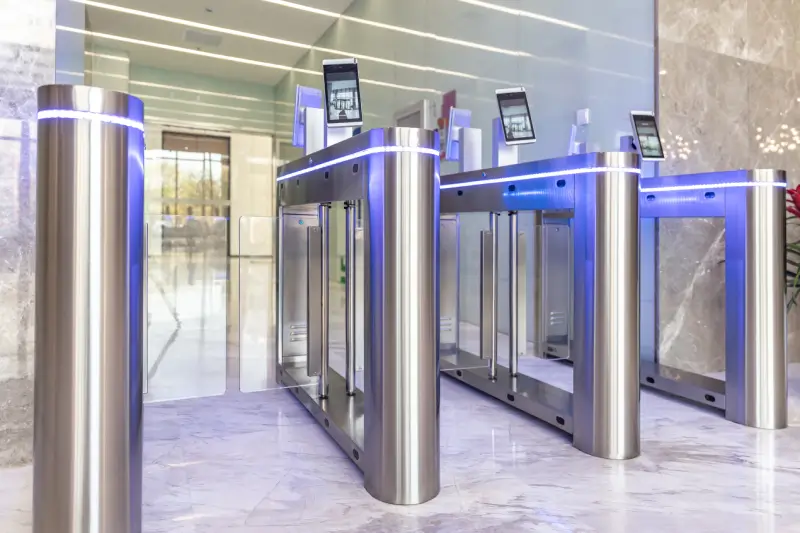
Security Turnstiles Are Changing How Commercial Buildings Manage Access
As businesses continue strengthening physical security, security turnstiles have become a common addition to commercial buildings looking to better manage pedestrian access without compromising efficiency.
From modern office lobbies to industrial facilities, today’s commercial security turnstiles support safer, more controlled entry while complementing broader access control strategies. Understanding the different types and where they’re most effective can help businesses make a more informed investment.
The Main Types of Commercial Security Turnstiles
Commercial turnstiles generally fall into four common categories: optical turnstiles, speed gates, tripod turnstiles, and full-height turnstiles. Each supports credential-controlled entry, but they differ in appearance, throughput, physical security, and ideal placement.
Optical Turnstile Access Control
Optical turnstile access control is often used in commercial interiors where the goal is to control access without making the entrance feel overly restrictive. Sensors monitor movement through the lane, while retractable or swing barriers respond to approved credentials.
Optical systems are commonly selected when businesses want:
- A modern lobby appearance
- Fast employee entry
- Clearly defined access lanes
- Compatibility with badge or mobile credentials
- A more open arrival experience
These systems are often a strong fit for corporate offices, financial institutions, healthcare buildings, and multi-tenant properties. Their main advantage is the balance between security and presentation.
However, optical systems typically require careful placement and integration planning. Lane width, pedestrian volume, visitor routing, and reception procedures all influence how effectively they perform.
Speed Gate Entry
A speed gate entry system is designed for fast pedestrian movement through controlled lanes. It is often chosen for larger commercial buildings where many employees arrive or leave during the same periods.
Speed gates are commonly evaluated for:
- Corporate headquarters
- High-occupancy office buildings
- Large commercial campuses
- Premium reception areas
- Properties with heavy morning and evening traffic
Their primary advantage is throughput. They can move authorized users quickly while maintaining individual credential verification.
A speed gate may be a stronger option than a standard optical lane when traffic volume is high, and the building requires both efficiency and a polished appearance. The trade-off is that these systems usually require more space, more detailed installation planning, and a higher investment than basic turnstile designs.
Tripod Turnstiles
A tripod turnstile uses three rotating arms to control one-person entry. It is a practical option for facilities where function, durability, and cost control matter more than architectural appearance.
Tripod turnstiles are often considered for:
- Manufacturing facilities
- Warehouses
- Distribution centers
- Employee-only entrances
- Staff access points
- Industrial properties
For a business seeking reliable credential-based access at a controlled employee entrance, a tripod design may offer the right level of security without unnecessary complexity.
The main trade-off is appearance. While effective, tripod turnstiles are more utilitarian than optical lanes or speed gates and may not suit reception areas where presentation is a major priority.
Full-Height Turnstiles
A full-height turnstile creates a floor-to-ceiling rotating barrier that allows one authorized person to pass at a time. It is generally selected for environments where stronger physical control is more important than speed or visual openness.
Common applications include:
- Outdoor commercial perimeters
- Utility facilities
- Industrial plants
- Restricted yards
- Government properties
- Critical infrastructure locations
A full-height system provides greater resistance to unauthorized passage than lobby-style turnstiles. It is especially useful where an entry point cannot rely on reception staff or an enclosed building lobby.
The trade-off is that full-height turnstiles create a more restrictive user experience and are not usually suitable for welcoming public-facing entrances.
Security Turnstile Types Compared — At a Glance
| Turnstile Type | Best Use | Primary Advantage | Main Consideration |
| Optical turnstile access control | Corporate offices, healthcare, financial institutions, multi-tenant lobbies | Modern appearance with controlled access | Requires careful lane and visitor-flow planning |
| Speed gate entry | High-traffic headquarters, large office buildings, commercial campuses | Fast throughput with a premium user experience | Usually requires more space and investment |
| Tripod turnstile | Manufacturing, warehouses, employee entrances, industrial facilities | Practical, durable, and cost-conscious | Less suitable for high-end public-facing lobbies |
| Full-height turnstile | Outdoor perimeters, utilities, restricted industrial areas | Strong physical access control | More restrictive and less appropriate for visitor-focused spaces |
No single turnstile type is universally better. The strongest choice is the one that matches the building’s traffic patterns, security level, visual requirements, and access control infrastructure.
Where Different Turnstiles Work Best
Understanding the hardware is only part of the decision. Businesses also need to consider the environment in which the system will operate.
Corporate Office Lobbies
Corporate offices often need a lobby turnstile system that supports security without making the space feel unwelcoming. Optical turnstiles and speed gates are typically the most suitable options because they provide a clean appearance and accommodate frequent employee movement.
A building with moderate traffic may perform well with optical lanes. A larger headquarters handling concentrated arrival periods may benefit more from speed gates.
Visitor procedures also matter. A lobby system should support approved guest access without creating confusion at reception or forcing staff to manually override the system throughout the day.
Multi-Tenant Commercial Buildings
Multi-tenant properties need to manage access for employees from multiple businesses, along with guests, service providers, and delivery personnel. In this environment, visitor flow management becomes just as important as employee credentialing.
Optical turnstiles or speed gates can provide separate credential-based entry lanes while helping reception teams direct guests through approved access points.
The selected system should align with the property’s tenant access policies and visitor management process rather than operating as an isolated barrier.
Manufacturing and Warehouse Facilities
Manufacturing plants, warehouses, and distribution centers often require dependable access at employee entrances, shift-change points, or restricted operational areas.
A tripod turnstile may be the most practical option when the goal is to verify employee credentials and regulate pedestrian movement without prioritizing lobby aesthetics.
Where exterior perimeter control is required, a full-height turnstile may be more appropriate. The decision depends on whether the access point is inside the building, outside the facility, or part of a secured yard.
Healthcare and Professional Facilities
Healthcare and professional environments often need controlled access without creating unnecessary friction for staff or approved visitors. Optical lanes can support a more open atmosphere while still reinforcing credential use.
The turnstile should not interfere with emergency movement, accessibility, reception procedures, or the flow of patients and visitors. For that reason, planning the surrounding entry process is just as important as selecting the equipment.
Industrial and Restricted Perimeter Sites
Industrial properties, utilities, and secured outdoor areas usually place greater emphasis on physical control than appearance.
A full-height turnstile can create a controlled pedestrian entry point along a fence line or restricted perimeter. It may also reduce reliance on manually managed gates where authorized personnel enter throughout the day.
These systems are generally better suited to controlled employee or contractor access than public-facing entry.
What Businesses Should Compare Before Buying
The product type is only one part of the purchase decision. Several operational factors can influence whether a turnstile performs well after installation.
Pedestrian Throughput
A turnstile must be able to handle the number of people expected during peak periods. A system that performs well during average traffic may still create bottlenecks during shift changes or morning arrivals.
Businesses should evaluate traffic by lane, not only by total daily occupancy.
Access Control Compatibility
Access control turnstile integration should be considered before hardware is selected. The turnstile may need to work with existing badge readers, mobile credentials, biometric devices, visitor platforms, or centralized access control software.
Compatibility should be confirmed early so the chosen system does not create unnecessary replacement costs or integration challenges.
Visitor Management
Employee traffic is predictable. Visitor traffic is not.
Buildings that receive clients, vendors, contractors, or temporary personnel should consider how guests will receive authorization and move through the turnstile. A well-designed lobby security barrier should support reception workflows rather than complicate them.
Accessibility
A commercial turnstile layout may require wider accessible lanes or alternative entry arrangements. Accessibility should be part of the initial design instead of being added after the main system has already been selected.
Indoor or Outdoor Placement
Indoor and outdoor applications have different requirements. Outdoor systems may need weather-resistant construction, stronger physical barriers, and different power or communication planning.
A lobby-focused optical system and an outdoor full-height turnstile solve very different problems and should not be compared on appearance alone.
Long-Term Expansion
A system should support anticipated changes in staffing, occupancy, credential technology, and building use. Businesses planning future growth may benefit from a modular design that allows additional lanes or updated credential readers later.
Common Turnstile Buying Mistakes
- One of the most common mistakes is selecting a turnstile based primarily on appearance. A visually impressive system may still be a poor fit if it cannot handle peak traffic or integrate with the existing access control platform.
- Another mistake is comparing only the initial equipment cost. Installation, electrical work, system integration, lane configuration, visitor processes, and future expansion all affect the overall investment.
- Businesses may also underestimate visitor traffic. A system designed only around employees can create delays when guests, contractors, and delivery personnel arrive without a clear credentialing process.
Finally, choosing a higher-security option than the environment requires can be just as problematic as choosing too little security. The goal is not to install the most restrictive barrier available. It is to create an entry system that matches the actual risk, traffic, and operational needs of the property.
Making the Right Turnstile Investment
The best security turnstiles are selected by matching the system to the building rather than forcing the building to adapt to the system.
Optical turnstiles and speed gates are generally stronger candidates for commercial lobbies where appearance and traffic flow matter. Tripod turnstiles often work well at controlled employee entrances. Full-height turnstiles are better suited to outdoor or higher-security perimeter applications.
A well-planned system should also account for credential technology, visitor procedures, accessibility, traffic volume, and future growth. Evaluating those factors together helps businesses make a more informed investment and avoid costly adjustments after installation.
Talk to an Honor Security Expert
Frequently Asked Questions About Commercial Security Turnstiles
How much do commercial security turnstiles typically cost?
The cost of commercial security turnstiles varies based on the turnstile type, number of lanes, access control integration, installation complexity, and site requirements. As a general guideline, businesses can expect to invest anywhere from $5,000 to $25,000 or more per lane, including equipment and installation. More advanced systems, such as optical turnstile access control or speed gate entry, typically cost more than tripod turnstiles, while customized projects or enterprise integrations may increase the overall investment. A professional site assessment is the best way to obtain an accurate estimate.
Can security turnstiles be installed in an existing commercial building?
Yes. Many security turnstiles can be incorporated into existing commercial buildings as part of a renovation or security upgrade. Before installation, factors such as available lobby space, power and network connections, accessibility requirements, emergency egress, and compatibility with the existing access control system should be evaluated.
Do security turnstiles help businesses meet compliance or security policies?
While security turnstiles do not certify compliance on their own, they can support organizational security policies by helping control authorized entry, creating auditable access points, and reinforcing credential-based access procedures. Depending on the industry, they may also complement broader physical security programs and access management requirements.
Can commercial security turnstiles work with mobile credentials and biometric readers?
Many modern turnstile systems can integrate with mobile credentials, smart cards, biometric readers, QR codes, and visitor management platforms. The available options depend on the selected turnstile model and the access control platform being used, so compatibility should be reviewed during the planning stage.
How long does it take to install commercial security turnstiles?
Installation timelines vary depending on the number of turnstiles, site preparation, electrical and network requirements, and integration with existing systems. Smaller projects may be completed in a few days, while larger commercial installations involving multiple entry lanes and software integration can take several weeks from planning to commissioning.
Are commercial security turnstiles suitable for small businesses?
Yes. While commonly associated with large office buildings, commercial security turnstiles can also be appropriate for smaller businesses that need controlled employee access, visitor management, or enhanced building security. The right solution depends on the facility layout, daily traffic, and operational requirements rather than business size alone.
Where can businesses install commercial security turnstiles in the Great Lakes Bay Region?
Businesses throughout Saginaw, Bay City, Midland, and the surrounding Great Lakes Bay Region can incorporate security turnstiles into office lobbies, healthcare facilities, manufacturing plants, educational campuses, industrial properties, and other commercial environments. The appropriate turnstile type depends on the building’s layout, security objectives, and pedestrian traffic.
What’s the difference between a security turnstile and a security gate?
Although both control access, security turnstiles regulate pedestrian entry one person at a time using credentials or authorization, while security gates are generally designed for vehicles or wider pedestrian openings. Many commercial facilities use both solutions together as part of a layered physical security strategy.
Honor Security provides commercial security solutions for businesses throughout Saginaw, Bay City, Midland, and the surrounding Great Lakes Bay Region. If you’d like to learn more about selecting the right security turnstiles for your facility or integrating turnstiles with your existing access control system, our team can help you explore commercial security solutions that align with your operational requirements, traffic flow, and security objectives.