
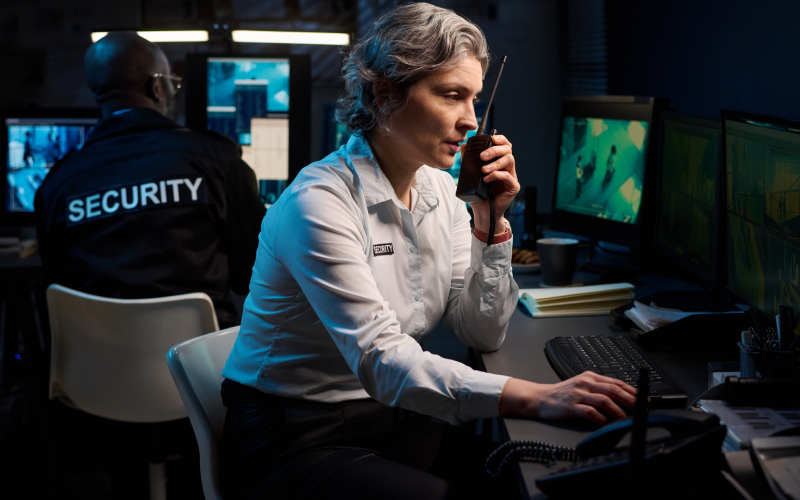
Commercial alarm monitoring is a 24/7 service where a central station watches your business security system, verifies alarms, and dispatches police, fire, or staff when an event is real. To pick a provider, prioritize a UL-listed central station, fast verified response, redundancy, and the ability to integrate monitoring with your cameras and access control.
An alarm that no one is watching is just a noise maker. Commercial alarm monitoring is the service that turns a triggered sensor into a verified response, any hour of the day. For a Michigan business, the right monitoring partner is the difference between a fast dispatch and an empty building alarming to no one. This guide explains what to look for and the standards that separate a serious provider from a cheap one.
What Is Commercial Alarm Monitoring?
Commercial alarm monitoring is a continuous service in which a central station receives signals from your alarm system, confirms whether the event is genuine, and contacts responders and your team. It covers burglar alarms, fire alarms, and environmental alerts, and it runs around the clock, including nights, weekends, and holidays when most break-ins happen.
Without monitoring, a triggered alarm relies on someone nearby hearing it and choosing to call. With a monitored service, every event is logged, verified, and acted on by trained operators.
Why Monitoring Matters for a Business
The case for monitoring is the case against waiting. The FBI reports an average loss of $2,661 per burglary, and most property crimes are never solved, so the value is in stopping the event, not investigating it later (Source: Federal Bureau of Investigation). Monitoring compresses the time between alarm and response, which is the window where loss is prevented.
What Is a UL-Listed Central Station?
A UL-listed central station is a monitoring facility independently evaluated by UL Solutions against the recognized standard for central station alarm services, UL 827, and audited for ongoing compliance. UL listing means the facility has met requirements for trained operators on duty at all times, redundant power and communications, and backup systems that keep monitoring running regardless of external conditions (Source: UL Solutions).
For fire alarm monitoring, the central station facility requirements are defined in UL 827, while the protected-property fire system follows NFPA 72, the National Fire Alarm and Signaling Code (Source: UL Solutions). When you ask a provider one question, ask whether their central station is UL listed. Much of what matters, staffing, equipment, and facility resilience, is covered by that listing.
How to Evaluate a Commercial Alarm Monitoring Provider
Use this checklist before signing:
- UL-listed central station with annual compliance audits.
- Redundant monitoring facilities and backup power and communications.
- Documented response and dispatch process, with a clear alarm response time expectation.
- Two-way voice monitoring service for verification and faster, accurate dispatch.
- Trained operators, ideally with recognized monitoring credentials.
- Video verification, so an operator can confirm an event on camera before dispatch.
- Local accountability: a Michigan-based integrator who installed and services the system, not just an offshore call center.
What to Expect on Pricing
Commercial alarm monitoring is usually a monthly fee that scales with system size, the number of signals monitored, and added services like video verification or fire monitoring. Treat low-cost, monitoring-only offers with caution: the value is in verified response and integration, not the lowest line item. A provider that designed and installed your system can monitor it with full context, which a disconnected monitoring-only vendor cannot.
Monitored vs Local Alarm
Is a local alarm enough for a business? Rarely. A local siren depends on someone nearby hearing it and calling. A monitored system routes every verified event to a central station that contacts your team and dispatches responders, even at 3 a.m. in an empty building. For commercial property, monitoring is the point of having an alarm at all.
How Monitoring Fits a Complete System
Monitoring is strongest when it is part of one platform. Tied into intrusion detection, cameras, and access control, a monitored event can pull the nearest camera for video verification, identify the door involved, and give the operator the context to dispatch accurately. That is the single-source integrator advantage: the company that designed your system also monitors it, so nothing is lost in translation between vendors.
Myth: All Monitoring Is the Same
Is one monitoring service as good as another? No. Facilities vary widely in certification, redundancy, operator training, and verification capability. A UL-listed station with video verification and a documented dispatch process is a different service than a bare signal-relay center, even if the monthly price looks similar.
More Questions Business Owners Ask
What does UL listing mean for monitoring?
It means UL Solutions has evaluated the central station against UL 827 and audits it for ongoing compliance, covering staffing, redundancy, and facility resilience (Source: UL Solutions).
Is video verification worth it?
Yes. It lets an operator confirm an event on camera before dispatch, which speeds genuine responses and reduces false dispatches.
Does monitoring work during an internet or power outage?
A properly designed commercial system uses backup power and redundant communication paths so monitoring continues through outages.
Can one company install and monitor my system?
Yes, and that is the advantage. A single-source integrator that installs and monitors your system has full context on every signal.
What is two-way voice monitoring?
It lets an operator speak through the system to verify an event or warn an intruder, improving dispatch accuracy.
Key Facts at a Glance
- A UL-listed central station is evaluated against UL 827 and audited for ongoing compliance (Source: UL Solutions).
- Fire alarm monitoring follows UL 827 for the central station and NFPA 72 for the protected property (Source: UL Solutions).
- The FBI reports an average loss of $2,661 per burglary, with most property crimes unsolved (Source: Federal Bureau of Investigation).
- Monitoring runs 24/7, including the nights and weekends when most break-ins occur.
- Video verification reduces false dispatches.
- Integrated monitoring gives operators camera and access context for accurate response.
Get Monitored Security Built and Watched by One Michigan Team
The right commercial alarm monitoring partner pairs a UL-listed central station with a local team that knows your building. Honor Security designs, installs, and monitors integrated security for Michigan businesses, so every signal is handled with full context.
Honor Security is a licensed Michigan commercial security integrator headquartered at 141 Harrow Lane in Saginaw, with documented client relationships exceeding ten years. Call 989-401-7070 or contact us online to talk through monitored security for your business.
Keep reading: