
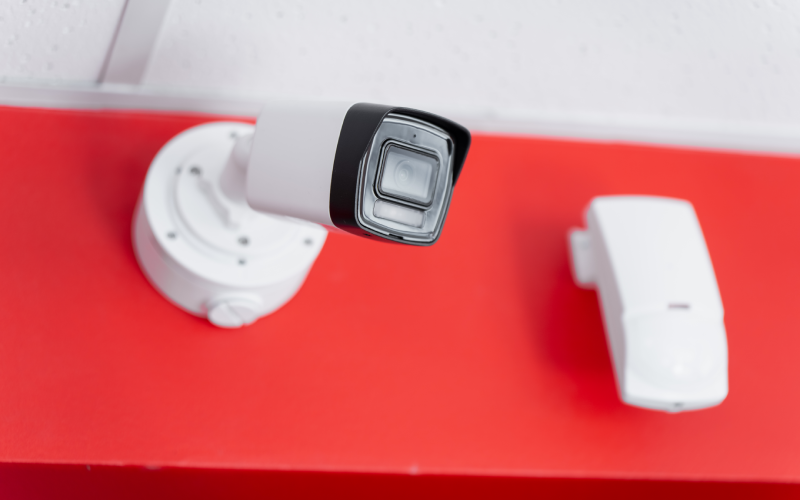
A motion detector alarm system uses sensors, most often passive infrared (PIR), to detect movement inside or around a building and trigger an alarm. For a business, the system should be professionally monitored, tuned to avoid false alarms, and integrated with cameras and access control. Coverage, sensor type, and central-station monitoring matter more than the number of sensors.
For a Michigan business, a motion detector alarm system, also called a commercial motion alarm system or business motion detector alarm, is the layer that catches what locks and doors miss: someone already inside, after hours, where they should not be. The technology is mature, but a commercial install is a different job than a consumer kit. Sensor choice, placement, monitoring, and integration decide whether the system stops a loss or just records one.
Why Commercial Motion Detection Matters
Burglary is still a real and expensive risk for businesses. The FBI reports an average loss of $2,661 per burglary, and only a minority of property crimes are ever solved (Source: Federal Bureau of Investigation). More than a third of burglaries occur at non-residential locations such as offices, warehouses, and retail space (Source: Federal Bureau of Investigation). Because recovery after the fact is unlikely, the value of a commercial grade motion detector is in fast detection and response, not in cleanup.
Physical security works best in layers, a principle the federal Cybersecurity and Infrastructure Security Agency frames as deter, detect, and delay (Source: Cybersecurity and Infrastructure Security Agency). Motion detection is the detect layer that turns a quiet break-in into an immediate, monitored alarm.
How Does a Motion Detector Alarm System Work?
A motion sensor watches a protected area and signals the alarm panel when it detects movement. The panel then sounds a local alarm and, if monitored, sends a signal to a central station that verifies the event and dispatches police. The most common commercial sensor is the PIR alarm sensor, which detects the heat signature of a person moving across its field of view.
The chain has four parts: the sensor detects, the alarm panel processes the signal, the system arms or disarms on schedule, and a monitored alarm routes verified events to responders. Each part has to be sized for a business, not a home.
Types of Motion Sensors for Commercial Security
Choosing the right sensor is the difference between reliable detection and constant false alarms. Use this comparison:
| Sensor Type | How It Detects | Best For | Notes |
|---|---|---|---|
| Passive Infrared (PIR) | Body heat moving across zones | Offices, retail, general interiors | Most common; can miss very slow movement; affected by heat sources |
| Microwave | Reflected microwave energy | Large open areas, warehouses | Wide coverage; can penetrate thin walls and over-trigger |
| Dual Technology | Requires PIR and microwave together | High false-alarm-risk areas | Fewest false alarms; both must trip to alarm |
| Outdoor/Curtain | Long-range or beam-shaped zones | Perimeters, loading docks, yards | Must be rated for Michigan weather and temperature swings |
A single-source integrator can match the sensor to each space rather than blanketing a building with one type.
The Michigan Cold-Weather Factor
Michigan winters put real stress on outdoor and unheated-space detection. PIR sensors read heat difference, so extreme cold, drafts near overhead doors, and big swings between heated and unheated zones can affect sensitivity and trigger nuisance alarms. Honor Security designs around Great Lakes Bay Area conditions: rating outdoor devices for sub-freezing temperatures, placing interior sensors away from heaters and loading-dock drafts, and using dual technology where false-alarm risk is highest.
How to Reduce False Alarms
False alarms cost money, erode police response priority, and train staff to ignore the system. Reduce them with this checklist:
- Use dual technology sensors in areas with HVAC drafts, heat sources, or moving stock.
- Keep PIR sensors away from vents, space heaters, and direct sun.
- Set arming and disarming schedules that match real business hours.
- Pet-immune or mass-tuned sensors where appropriate (warehouses, facilities with movement).
- Pair motion alarms with cameras so an operator can visually verify before dispatch.
- Test and service sensors on a preventative maintenance schedule.
Local Alarm vs Monitored Motion Alarm
Should a business use a local siren or a monitored alarm? Monitored, in almost every case. A local-only alarm makes noise and hopes someone calls. A monitored motion alarm sends every verified event to a central station that contacts the business and dispatches law enforcement, day or night. For an unattended building overnight, monitoring is the entire point.
How Motion Detection Fits a Complete System
A motion detector is one part of commercial intrusion detection. Its value multiplies when it is tied into the alarm panel, cameras, and access control through one platform. Alarm panel integration lets a motion event pull up the nearest camera, flag the door involved, and give a monitoring operator the context to act. That is the single-source integrator advantage: one coordinated system instead of disconnected devices from different vendors.
Myth: More Sensors Means Better Protection
Does adding more motion sensors make a building safer? Not on its own. Poorly placed or wrong-type sensors create coverage gaps and false alarms no matter how many you install. Detection quality comes from the right sensor in the right place, tuned correctly, and verified by cameras and monitoring, not from sensor count.
More Questions Business Owners Ask
What is the best motion sensor for a commercial building?
For most interiors, a quality PIR works well. For warehouses and high-false-alarm areas, dual technology sensors are the safer choice because both elements must trip to alarm.
Do motion detectors work in the dark?
Yes. PIR sensors detect body heat, not light, so they work in complete darkness.
Will a motion alarm work during a power outage?
A properly designed commercial system includes battery backup so detection and monitoring continue during an outage.
Can motion sensors trigger cameras?
Yes, and they should. Integrating motion alarms with cameras lets a monitoring operator verify an event before police are dispatched, which reduces false dispatches.
How many motion sensors does my business need?
It depends on the floor plan, entry points, and high-value areas, not square footage alone. A site assessment determines real coverage needs.
Key Facts at a Glance
- The FBI reports an average loss of $2,661 per burglary, and most property crimes go unsolved (Source: Federal Bureau of Investigation).
- More than a third of burglaries occur at non-residential locations (Source: Federal Bureau of Investigation).
- Physical security is strongest in layers: deter, detect, delay, respond (Source: Cybersecurity and Infrastructure Security Agency).
- PIR is the most common commercial sensor; dual technology cuts false alarms.
- Monitored motion alarms route verified events to a central station for dispatch.
- Michigan cold and drafts require weather-rated, well-placed sensors.
Protect Your Michigan Business with Monitored Motion Detection
A motion detector alarm system is only as good as its design, tuning, and monitoring. Honor Security engineers commercial intrusion detection for Michigan businesses, from a few interior sensors to a fully integrated alarm, camera, and access platform, with a Saginaw-based team and statewide coverage.
Honor Security is a licensed Michigan commercial security integrator headquartered at 141 Harrow Lane in Saginaw, with documented client relationships exceeding ten years. Call 989-401-7070 or contact us online for a commercial intrusion detection assessment.
Keep reading: